

November 19, 2026
The National Motorcyclists Council (NMC) is calling on Government and other authorities to end the longstanding exclusion of motorcycling from the transport policy aspects of the Safe Systems approach, ensuring that motorcycling is fully recognised within the development of a comprehensive Safe System approach to motorcycle safety.
With the Government committed to reducing road deaths and serious injuries in Great Britain by 65% by 2035, the NMC warns that these ambitions cannot be achieved without addressing the risks faced by motorcyclists through a coordinated approach embracing transport policy, planning, infrastructure, vehicles, road users and post-crash response.
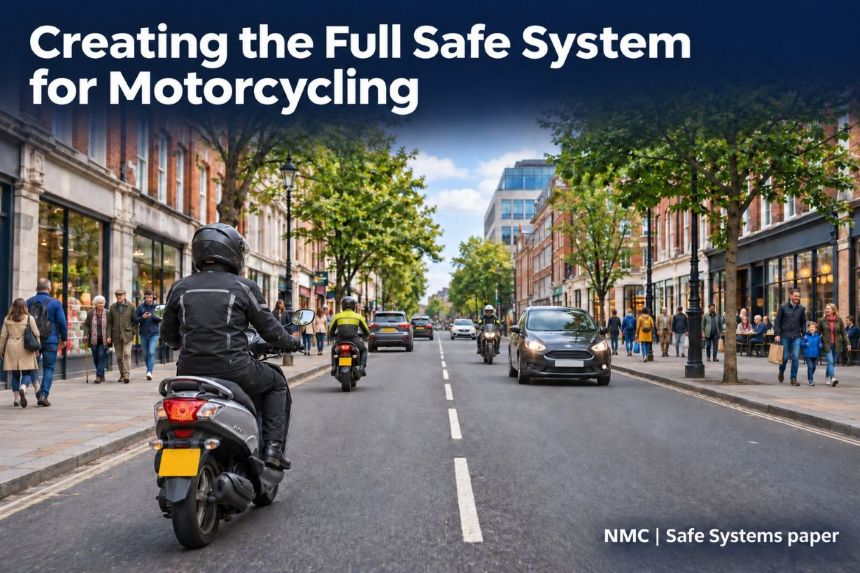
The NMC has published a new paper calling for a comprehensive approach to motorcycle safety, arguing that recognising motorcycling’s contribution to society and tackling its safety challenges must go hand in hand. It proposes a full Safe System structure for motorcycling, with transport policy and planning underpinning coordinated action on infrastructure, speeds, vehicles, road users and post-crash response – as the Safe System does for other vulnerable road users.
The WHO & UN, Global Plan for the Decade of Action for Road Safety 2021-2030 states that road transport is a complex system and that road safety remedies should be sought throughout that system rather than by merely holding road users to account. It then identifies multimodal transport and land-use planning as an important starting point for implementing a Safe System. For motorcycling, this is a core element which is often absent when it comes to transport and road safety policy
The NMC warns that leaving these essential elements disconnected or absent has a human cost. Without a coordinated approach that addresses risks throughout the transport system, riders remain exposed to hazards that could be reduced or removed.
Motorcycling provides independent transport, supports employment and business, and connects communities. Around two-thirds of motorcycle mileage in the UK is undertaken for commuting, access to education, employment and training, and other practical purposes. The sector also supports manufacturing, engineering, retail, logistics, tourism, leisure, heritage and sport.
Yet motorcycling’s contribution is too often absent from the policies that shape transport networks, the paper argues, with motorcycles viewed primarily as a safety problem to be managed. The NMC argues that this approach must change. Motorcycling should be recognised alongside other forms of personal transport, with its needs and potential properly reflected in transport strategies, infrastructure investment, planning decisions and road safety policy – all components of a full safe system.
The Safe System approach recognises that people make mistakes and that responsibility for safety is shared between road users and those who design and manage the transport system.
The NMC paper identifies a significant gap in how this approach is often applied to motorcycling. While motorcycle safety frameworks address riders, vehicles, roads, enforcement and emergency response, they can overlook the transport policy and planning decisions that shape the system itself.
This has practical consequences. When motorcycles are excluded from wider transport planning, opportunities can be missed to improve infrastructure, standards, research, data, parking, access, emerging technology and other road users’ awareness of riders. The NMC argues that closing these gaps is essential to preventing avoidable deaths and life-changing injuries.
The paper challenges approaches that seek to discourage or sideline motorcycling as a principal safety strategy. With motorcycle use continuing to grow across many parts of the world – rising by nearly 14% in the UK alone since 2013, it argues that policy must address the needs of riders who already use the network and those who will use it in future.
It also identifies existing UK guidance, policy and research as foundations for progress. These should be brought together, updated and embedded in mainstream transport policy, with motorcycling recognised as a mobility option across urban, suburban and rural settings.
The paper calls for Government and other public authorities to:
• Embed motorcycling within the Safe System. Ensure motorcycles and scooters are fully represented in national and local transport strategies and planning policy Recognising that transport policy and planning are fundamental to the delivery of safer roads and safer journeys
• Ensure infrastructure and investment decisions reflect the needs of motorcyclist. Include road design, maintenance, parking, access and emerging transport technologies
• Establish coordinated responsibility for motorcycle safety. Bring together Government departments, local authorities, road authorities, riders groups, industry, enforcement agencies and emergency services.
• Use evidence and research to inform policy. Ensure motorcycle-specific data, risk assessments and safety considerations are incorporated into transport and road safety decisions.
Craig Carey-Clinch, NMC Executive Director, said: “"The Government has set itself an ambitious target to significantly reduce road deaths and serious injuries 2035. But it cannot realistically achieve that ambition while motorcycling continues to be overlooked in the development of transport policy and road safety planning.
Government needs to move beyond fragmented safety interventions and embrace a comprehensive Safe System that recognises motorcycling within transport planning policy, addresses the risks riders face and makes everyone responsible for delivering safer journeys.
This is not simply about protecting motorcyclists. It is about creating a transport system that works safely and effectively for everyone"
The NMC’s central message is that a Safe System must include every road user. Fully integrating motorcycling into transport policy is an essential step towards reducing rider risk and realising the mode’s wider transport, economic and social benefits. Failing to do so will perpetuate an unsafe system where motorcyclists remain more vulnerable than should be the case, with casualty numbers remaining at worrying levels.
ENDS
Notes to Editors.
The NMC Safe Systems Paper can be found here: https://cdn.prod.website-files.com/60364ce44148d168e4193d50/6aff1f8c62d5f9b80b0f0144_NMC%20Safe%20System%20for%20Motorcycling%20November%202026.pdf
For further information, please contact Craig Carey-Clinch on 07979 757484 | craig@uknmc.org
The NMC also publishes comment and shares relevant partner news and announcements on social media. You can follow the NMC on X: @OfficialUKNMC | Facebook: OfficialUKNC | LinkedIn national-motorcyclists-council
(Pic: NMC / AI)

